Parlay Calculator
18+ · BET RESPONSIBLY
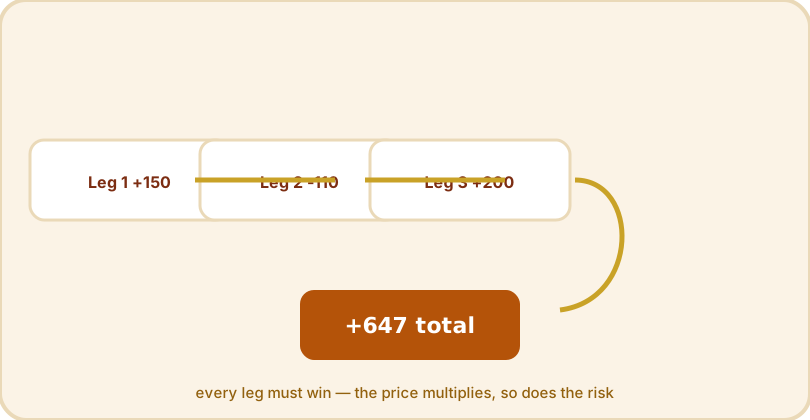
A parlay bundles several bets into one ticket where every leg must win. The combined price is simply the product of each leg's decimal odds — this calculator does the multiplication and shows the payout.
Reading the result honestly
The calculator shows what the ticket pays, not what it earns. Each leg carries the bookmaker's margin, and in a parlay those margins compound too — a three-leg parlay of standard -110 legs carries roughly triple the house edge of a single -110 bet. That is the trade: multiplied price for multiplied risk, which is why professional bettors treat parlays as entertainment pricing rather than value pricing — and why a small, fixed stake is the correct way to buy one.
Leg counts and what they do to the price
| Legs | Typical price (all -110) | True win chance |
|---|---|---|
| 2 | ≈ +264 (3.64) | ≈ 27.4% |
| 3 | ≈ +596 (6.96) | ≈ 14.4% |
| 4 | ≈ +1234 (13.34) | ≈ 7.7% |
| 5 | ≈ +2435 (25.35) | ≈ 4.1% |
The win-chance column is why the entertainment framing matters: a five-leg parlay of standard prices is a four-in-a-hundred ticket before margins stack on top.
A worked example
Three legs: +150 (decimal 2.50), −110 (1.909) and +200 (3.00). Product: 2.50 × 1.909 × 3.00 = 14.32. A $50 stake returns $716 if all three win — profit $666. Now the honest column: each leg's implied probability is 40.0%, 52.4% and 33.3%; multiplied, the ticket's true chance is about 7.0%. A fair price for a 7% shot is 14.32 decimal — exactly what you were offered, which is the point: the parlay price is only fair when the legs are fairly priced, and each single leg quietly carries the book's margin. Stack three margins and the entertainment is priced like entertainment.
When parlays make sense anyway
For most bettors, never as a strategy — but as a ticket shape, they can earn their keep when small stakes buy compounding fun: $10 on a five-leg Sunday slate is dinner-money risk for a genuinely interesting afternoon. The failure mode is stake creep: parlays that "almost hit" invite doubling down, and the multiplication that built the payout builds the losses at the same rate. If you take one rule from this page: size the parlay stake at the entertainment level, not the investment level, and the math works for you in both directions.
Same-game parlays
Correlated legs from one game (a quarterback over plus his team winning) are priced by the book with the correlation removed — the offered price is usually well below the true mathematical product. The arithmetic here still applies to the price you are shown; just know the discount came out of your side.
Frequently asked questions
How is a parlay payout calculated?
Convert every leg to decimal odds and multiply them together; that product is the combined decimal price. Payout equals your stake times the product — but only if every leg wins.
Why do parlays pay more than single bets?
Because the probabilities multiply. Two 50% legs win together only 25% of the time, so the fair price is roughly the square of the single price — the compounding is the compensation for compounding risk.
Do pushes (ties) void a parlay leg?
Most books drop a pushed leg and re-price the parlay with the remaining legs, rather than voiding the whole ticket. Rules vary by book — read yours before leg day.