Implied Probability
18+ · BET RESPONSIBLY
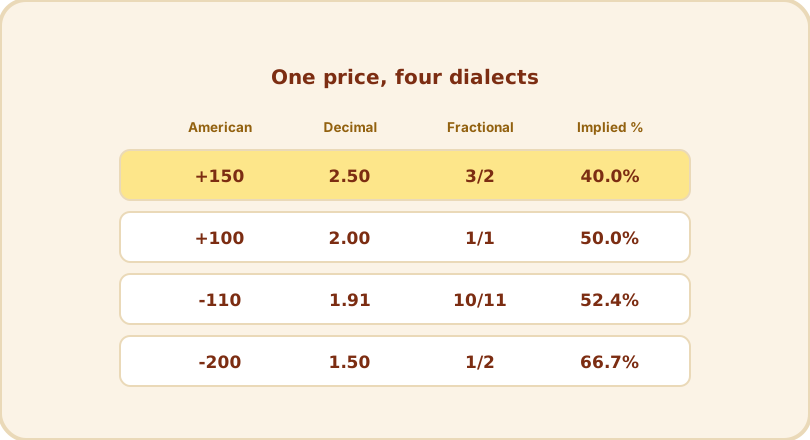
Odds are a language for probability. Read the translation and every price becomes a statement you can argue with: this bet wins 40% of the time, that one 52.4%.
The two formulas
| Format | Implied probability | +150 example |
|---|---|---|
| Positive American (+) | 100 ÷ (odds + 100) | 100 ÷ 250 = 40.0% |
| Negative American (−) | |odds| ÷ (|odds| + 100) | −150 → 150 ÷ 250 = 60.0% |
| Decimal | 1 ÷ decimal odds | 2.50 → 40.0% |
The homepage converter does this automatically for any price; the table below is the why-it-works reference.
The overround: why a fair coin is not priced 50/50
Price an even match at -110 on both sides: each side implies 52.4%, summing to 104.8%. Nothing is wrong with the math — the extra 4.8% is the market's fee, the "vig" or "juice". This is why arbitrage hunting works at all: two books' overrounds can leave a combined sum under 100%, and the gap is the arb margin.
Practice prices, with answers
| Price | Work | Implied |
|---|---|---|
| +300 | 100 ÷ 400 | 25.0% |
| −250 | 250 ÷ 350 | 71.4% |
| 1.80 decimal | 1 ÷ 1.80 | 55.6% |
Cover the answers, compute all three, and you own the skill — everything else on this site is this move repeated.
From implied to your own number
The professional habit is unpricing: convert the offered price to implied probability, then compare it with your own estimate from anything better than the market's baseline — injuries data, home-field models, or simply a more careful read. Where your number exceeds theirs, the bet is +EV in the long-run sense: not a promise about tonight, but a positive expectation repeated many times. Where it does not, the price is the house's, and the entertainment is the product.
Margin, seen from both sides of the counter
The overround explains nearly every pricing habit that confuses newcomers. Why is the even match -110/-110 instead of +100/+100? Margin. Why do exotic markets (first scorer, exact score) carry worse implied sums than the moneyline? More uncertainty means books pad more margin. Why does the last minute of a close game offer worse prices than the opening line? Late money sharpens the line and the margin stays — the sharp bettor's answer is to price early, when books know least.
A worked example, end to end
Book offers +200 on a team you estimate wins 38% of the time. Implied probability: 100 ÷ 300 = 33.3%. Your 38% beats their 33.3% by 4.7 points — that is a value bet at this price. Stake sizing systems (Kelly and relatives) exist to turn that edge into a betting plan without risking the bankroll on any single Tuesday — but the edge itself is the whole game, and this page is where you learn to find it or conclude, honestly, that you do not have one.
Frequently asked questions
What is implied probability in one sentence?
The chance of winning that the price implies: decimal odds divided into 100% — a 2.50 underdog "should" win 40% of the time.
Why do both sides' probabilities sum over 100%?
The extra is the bookmaker margin (vig or juice). A -110/-110 market sums to 104.8%: the 4.8% overround is how the book earns regardless of outcome.
How do I use it to find value?
If your honest estimate of a result is higher than its implied probability, the price is better than the risk — that gap, not the payout size, is what value bettors chase.